
Breaking the Mold
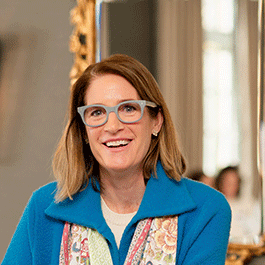
As an educator, investor, and founder, Kate Jackson highlights the ways in which she works to combat the exclusion of women from entrepreneurial spaces.
Professor Kate Jackson has always seen the world through an entrepreneurial lens. From growing up in the Bay Area during the rise of startups like Google to founding multiple ventures of her own, she understands entrepreneurship to be a field full of opportunities for those with an impulse for innovation.
However, Jackson has found that entrepreneurial spaces aren’t always inviting for women. Despite women-led startups generating greater revenue than men-led startups, they experience comparatively less financial and structural support for their startups.
“Women have always been part of the economy. We are a great investment, and that's one of the things that I’m working on here in Chicago,” she said.
Jackson — who will be teaching the Farley class ENTREP 395: Social Impact: Build What Matters in Spring 2027 — has worked as an educator, an angel investor, and the founder of several ventures to foster entrepreneurial ecosystems where women not only belong but thrive. Her non-profit venture, Girl Gonna Launch, sprang from exactly that goal: To empower young women to be confident and passionate in anything they do.
In this conversation with Jackson, she shares her own experiences and insights into the start-up world and how women can carve out spaces for themselves in it.
You come from a family of pioneers and entrepreneurs. How has that influenced your perspective on entrepreneurship?
I grew up in Silicon Valley in the ‘80s and ‘90s and saw everyone around me working for startups or becoming entrepreneurs. My father was a lawyer and my mother was an accountant, and they supported this nascent startup ecosystem.
I just thought that's what people do—people start businesses, and everyone can do it. There wasn't this sense in my head that it was for boys and wasn't for girls.
What challenges do women face when trying to enter entrepreneurial spaces?
I do see entrepreneurship as the American dream, and so everybody should have access to it. That said, that's not really what society believes.
There is this view that men succeed in entrepreneurship because entrepreneurship is this brutal warfare and you must win at all costs. You have to be an “alpha” to win. There’s this male-coded and violent language to entrepreneurship to which feminine traits are somehow antithetical.
I don't think any of that is true, but I think that that seeps into our views of ourselves and our place in entrepreneurship. Women count themselves out before they've tried.
When they do try, women still face roadblocks. In pitch competitions, women are most likely asked, “How will you not fail?” Men are asked, “How will you succeed?” The assumption that women aren’t cut out for entrepreneurship is baked in there.
How might the entrepreneurial mindset taught at Farley help to counteract these negative associations?
Part of the entrepreneurial mindset we teach is learning to listen closely to the voice of our own inner critic, and then to question it. Anyone who has ever started something knows the feeling: you step into territory no one has mapped for you, and the uncertainty is enormous. Into that empty space, doubt comes rushing in. The quiet, corrosive thoughts: “you’re not ready, this won’t work, who are you to try.” Or: “girls aren’t builders, this isn’t your field, you don’t quite belong here.” Left unchallenged, a promising founder can talk herself right out of her own idea before she ever gets the chance to test it.
So, we teach Farley students to battle with these thoughts, not by pretending the doubt isn't there, but by refusing to let it have the last word. That empty space will fill with something; the only question is what. We help students fill it more intentionally, answering the harsh inner voice with a fairer one: you've done the work, you're more ready than you feel, the only way to know is to try. It sounds almost too simple to matter. But I've watched it carry a hesitant student from the edge of giving up to the moment she finally pitches her idea out loud. And for a young founder, that moment is everything.
How has the entrepreneurial world changed for women throughout history?
Women have always been inventors and innovators, but we’ve often been barred from participating in the economy. In the United States, women weren’t allowed to own property for a long time, including intellectual property like patents. Women were written out of the history they helped to define.
When women do found startups, they don't get the funding they need. They get, at most, 2 percent of venture capital funding. That's it.
On the whole, though, women do better at entrepreneurship. If you look at women who get funding, their returns are greater than men’s. For every dollar that's invested, women-founded teams return 78 cents, and men-founded teams only return 31 cents. Women hire more women, and the gains compound over time.
What does it mean to you to have founded two ventures that focus on uplifting women?
I'm very lucky, and I worked hard to get to this point where I can help women and girls during transitional stages in their life. I founded Girl Gonna Launch, a summer camp that helps girls in middle school and early high school see themselves as entrepreneurs.
When girls are young, they have all this confidence and unbridled enthusiasm. In middle school, around ages 11 to 13, that confidence really falls off. I'm trying to intervene in those critical years where girls start to absorb what society is telling them about themselves.
What is funny to me, when the camp starts, the girls say, “Business is not for me.” But as they work through the camp, they meet like-minded girls, they perform all the steps of entrepreneurship at an accelerated pace, and then they make their final pitch. They might be scared, but they do it, and then that's really where that confidence starts to blossom. These girls learn they can do these things that they didn't think that they could before, and it's so rewarding.
I also co-founded WM Retreats, which is focused on helping women through menopause. There's a lot of stigma around menopause, and women don't feel comfortable talking about it. Our goal is to create a space where women can share their fears and frustrations, while also have their questions answered by a real expert.
For so many centuries, women were told to just ignore menopause, and then they'd have these terrible health outcomes. We're talking to women about how to take this time between 45 to 55 to focus on their mental health and physical health, because if women use this time wisely, they lower their risk of heart disease, dementia, and osteoporosis.
How has being a woman shaped your experience as an entrepreneur?
In a sense, being a woman is my market research. It lets me see problems that sit in plain view yet stay easy to miss for a good share of the population (eg, the confidence that quietly drains out of girls somewhere around middle school, the way menopause is still whispered about in workplaces). I don't have to imagine these problems. I've lived alongside them my whole life.
That clarity comes with gentle friction. Not everyone sees these problems the way I do, and honestly, why would they? It's hard to feel the weight of something you've never had to carry. When someone has wondered aloud whether the need is really there, I've learned that the most useful response isn't to argue but simply to explain: you’re not the ICP (ideal customer profile). The girl losing her voice in seventh grade is. The woman powering through a hot flash in a meeting is. A problem doesn't have to be visible to everyone to be real.
And the truth is, more people see it than I expected. A real surprise of running these camps has been the fathers. The dads who drop their daughters off each morning don't dismiss a girl's interest in building a business; they champion it. I'll confess this caught me off guard. I'm a mother, and a mother of boys, and I'd arrived carrying my own quiet assumptions about how "girl dads" might feel about all this. I was wrong, and I'm glad I was. It turned out the allies I'd been looking for were often already there in the drop-off line, holding a backpack and waving goodbye.
What advice would you give to young women at Northwestern who are interested in entrepreneurship?
If you’re starting a venture, shout it from the rooftops. Tell everybody and anybody what you're working on. We, as women, need to toot our own horn!
In terms of Northwestern students who want to get into entrepreneurship: Take a class, come to Farley! It's really a fun, welcoming, and inclusive community. If you're entrepreneurially curious, take a class at Farley and see if you like it!